Cheap alternatives are how good decisions die.
Design decisions used to be protected by the cost of producing an alternative, and AI removed that cost. If the reasoning was never written down, it is now up for grabs.
- Published
- Reading time
- 4 min
- Length
- 846 words
- Share
The counter-prototype arrives on a Monday morning. A stakeholder spent part of the weekend in v0 or Lovable, and what they built looks real: styled, responsive, filled with believable content. It contradicts a direction the team decided six weeks ago, after research, debate, and a signoff everyone attended. And the room takes it seriously, because it looks exactly as finished as the work it wants to replace.
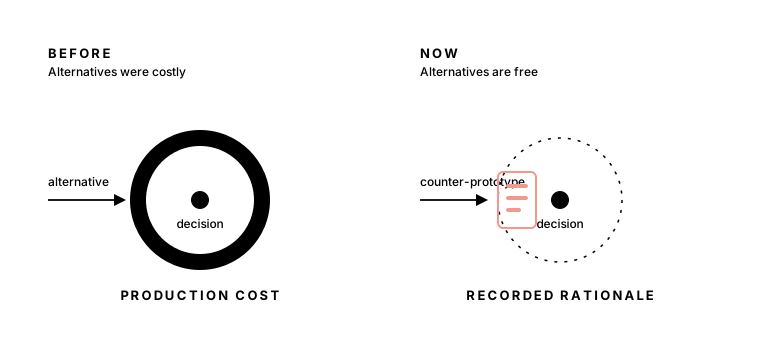
The instinct is to be annoyed with the stakeholder for reopening a settled question. I think that instinct misreads what settled the question in the first place. Most design decisions were never protected by the agreement in the room. They were protected by how expensive it was to produce an alternative, and that protection is gone.
The moat was never the argument
What kept decisions closed was rarely the strength of their rationale. It was the price of challenging them. Countering a decided direction used to require a team, a budget, and enough conviction to spend both, so casual objections died on the cost alone. The decisions that survived looked sturdy, but nobody could afford to test the wall they stood behind.
Now anyone with an evening and a prompt can put a convincing alternative in front of a decision-maker. I know how little it takes because I build with these tools daily: producing a credible counter to my own decided work takes about an hour. The barrier that used to do the protecting has quietly dropped to zero, and most teams have not replaced it with anything.
Production cost was the moat around your decisions, and AI just drained it.
The artifact was carrying the argument
Teams rarely wrote down why they decided anything, because the artifact made the question feel closed. The approved design existed, it looked deliberate, and rebuilding it differently was nobody’s idea of a good week. The reasoning lived in a deck nobody reopened. The rest left with the people who held it.
That held as long as the artifact was unmatched. Set an equally polished alternative next to it and there is suddenly nothing to point at: no recorded evidence, no rejected options, no trace of the tradeoffs. The comparison collapses into taste, and taste is a fight the loudest person in the room can win.
None of this is a case against the tools. My team works prototype-first, and a prototype is still the fastest honest way to make a decision. But the same speed cuts both ways: the thing best at opening a question is now also the thing best at reopening it, and the problem is not the prototype. It is that nothing else was holding the decision up.
Write the decision down while the room still agrees
The defense that still works is a written record of the rationale, made at the moment of decision. Software engineering has a name for this, the architecture decision record: a short, dated document capturing what was chosen and why, kept where the work lives. Design teams mostly have no equivalent, which is strange for a discipline whose decisions get challenged far more often.
- What was decided. One sentence, plain words, no design vocabulary.
- What was rejected. The alternatives considered, including the attractive ones, and why they lost.
- What evidence carried it. The test result, the number, the constraint that made the call.
- What would reopen it. The conditions under which a challenge is legitimate, so a challenger has a path that is not a Thursday prototype.
The sturdiest decision I have carried through delivery was a hospital network’s move to patient-first navigation, and it held for exactly this reason: the evidence traveled with it into every meeting where a service-line owner wanted it reversed, and the outcome eventually backed the call (+40% online booking starts, organic, in the year after launch). The decision held because the reasoning kept showing up in the room.
What a record has to contain to survive contact with a good-looking alternative is something we are still finding out.
Defend the record, not the artifact
The next time a counter-prototype lands in your inbox, notice what you reach for. If it is a better-looking artifact, you have entered an arms race where both sides can build overnight. Reach for the record instead. Test the challenger against the evidence that made the original call, and if it wins there, the decision deserved to change.
And if there is no record to test it against, that is the real finding. Protecting a decision through delivery was always a leadership job; production cost just used to do most of it quietly. Now it has to be done on purpose, in writing, starting with the next decision your team makes.

Director of Experience at Primacy. I find the order complex systems are missing: experience strategy, information architecture, and design systems for hospital networks, universities, and insurers.
Keep reading
- Oct 21, 2025
We automated the apprenticeship
A junior on my team turned a rough brief into a polished prototype before lunch, and it worried me. The production drudgery AI just removed was where judgment formed, and that training now has to be rebuilt on purpose.
PracticeLeadershipAI4 min - Sep 19, 2026
UX will outlive its job title
The job of understanding people and shaping what they meet has outlived four titles. It will outlive this one too, with less drawing and more deciding in it.
PracticeUXAI7 min