Nobody is searching for otolaryngology.
Patients search by symptom, condition, and body part. Hospital sites answer in the language of departments, so every marketing dollar drives traffic into a vocabulary wall the navigation built.
- Published
- Reading time
- 4 min
- Length
- 850 words
- Share
Someone finds a lump on their neck at two in the morning and starts typing. The queries are “lump on neck,” “swollen gland,” “trouble swallowing.” Nobody types “otolaryngology.” Yet on most hospital sites that is exactly where the answer lives, filed under a department name the person searching cannot spell and has never said out loud, and a search that should have ended in an appointment ends at the back button instead.
I have watched this play out for a decade across healthcare engagements. The complaint arrives as “patients can’t find our services” or “our SEO is weak,” and the proposed fix is a campaign budget or a search retainer. But the problem is usually closer to home. The site is organized in a language its audience does not speak, and no amount of traffic fixes a vocabulary wall.
Patients search the way symptoms feel
People look for care by symptom, condition, and body part, almost never by specialty. Google has said that roughly 7 percent of its daily searches are health-related, over a billion a day. The phrasing is bodily, not clinical: things hurt, swell, itch, and will not go away. Medicine’s names for itself barely appear.
This is not an education gap you can wait out, either. The 2003 National Assessment of Adult Literacy found that only 12 percent of U.S. adults were proficient in health literacy. The other 88 percent are the patients your site exists for, and they are not going to learn the org chart before they get sick.
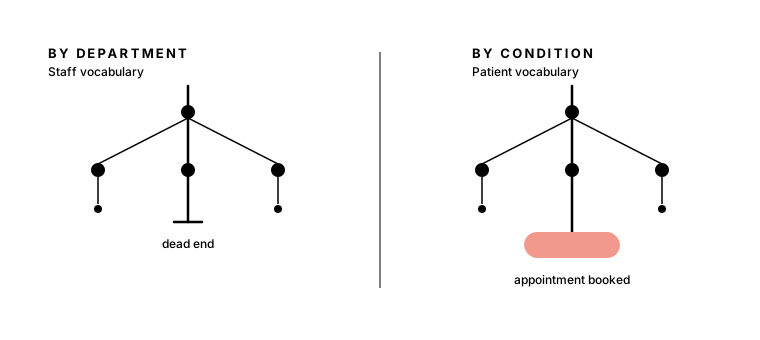
Our own tree tests keep saying the same thing. Hand people a realistic task and they navigate by condition and body part, stalling the moment the tree forces them to pick a department. Nobody fails to find care because the pages are missing. They fail because the words at the fork are not theirs.
The navigation is a staff directory in disguise
Hospital sites are organized by department because departments are how the institution knows itself. Clinical taxonomy exists for real reasons: credentialing, billing, referrals, the org chart. Those names are load-bearing inside the building. The trouble starts when they migrate onto the website unchanged, because those names were never meant for the person outside the building.
A hospital’s navigation is its staff directory in disguise. Patients arrive carrying a symptom, not a specialty.
That is also why the SEO retainer keeps disappointing. The queries are written in patient language, the pages are titled in clinical language, and the two rarely meet. So the marketing budget goes to buying back visitors the taxonomy turned away.
Translation is harder than renaming
Patient language and clinical taxonomy do not map one to one, which is why this is not a relabeling exercise. Dizziness can belong to neurology, cardiology, or ENT depending on the cause. Back pain fans out across orthopedics, neurosurgery, and pain management. A label that feels obvious to a patient can be clinically wrong in ways only physicians will catch, so the translation layer is content strategy with clinical review built in, not a copywriting pass.
I underestimated this the first time. I assumed that once everyone agreed to use patient language, the mapping would be mechanical. It was not. It was the slowest part of the work, and the part that needed clinicians in the room far more than it needed designers.
It is worth the slog. On a hospital network where we flipped the primary navigation from department-first to patient-first, conditions and plain names on top with the clinical structure underneath, online booking starts rose 40 percent, organic, in the year after launch. Same doctors, same departments, different words in front of them.
Start with the search bar, not the sitemap
The patient vocabulary you need is already sitting in your search logs. Before the next campaign brief or redesign kickoff, do three things.
- Pull the queries. A year of internal site search plus the GA4 terms that land people on your service pages is a corpus of patient language you already own, in their words and at scale.
- Test labels before layouts. Run a tree test that pits your department names against condition and body-part names on the same tasks, and let completion rates pick the labels.
- Layer, don’t demolish. Keep the clinical taxonomy underneath for billing, credentialing, and referrals. The public navigation should be a translation of it, not a mirror of it.
None of this waits on a redesign, and all of it should happen before another dollar goes to driving traffic. Nobody is searching for otolaryngology. Someone is searching, right now, for the lump on their neck, and the site that answers in those words is the one that turns a 2am search into an appointment.

Director of Experience at Primacy. I find the order complex systems are missing: experience strategy, information architecture, and design systems for hospital networks, universities, and insurers.
Keep reading
- Jul 19, 2026
Left navigation isn't faster, it's first
A controlled study moved the menu to the right and nobody slowed down. The side you pick doesn't set speed; it sets whether a visitor meets navigation or content first.
StrategyInformation ArchitectureUX8 min - Jun 28, 2026
The university homepage is a treaty, not a front door
Every university homepage is cluttered in the same way, and the reason is not design. The space is divided by internal seniority, not visitor need, and no layout fixes a negotiation.
StrategyHigher EdInformation Architecture5 min