Good work looks like failure at 90 days.
Structural work pays off on a lag, as search re-indexes and habits re-form long after the quarterly review has rendered its verdict. Negotiate the measurement window before launch.
- Published
- Reading time
- 4 min
- Length
- 867 words
- Share
There is a meeting that happens about ninety days after a structural relaunch. Someone opens the dashboard, the line is flat, and the room quietly does the math on what the work cost. I have sat in that meeting, and the work on the screen was not failing. It was doing what structural work does, which is pay off on a delay the review calendar was never built to see.
“The redesign didn’t move the numbers” is usually a measurement-window problem wearing an outcome costume. The work changed the structure. The structure changes behavior through systems that update slowly, and the number everyone is staring at moves last.
The lag is the mechanism, not an excuse
Structural work lags because the two systems it acts on, search engines and human habits, both update on their own schedules. Restructure a large site and you have changed thousands of URLs at once. Search engines take months to re-crawl the new architecture, trust the redirects, and re-rank the pages, and while they work through it, organic traffic can sit at or below the old baseline. On a dashboard, that recovery period is indistinguishable from failure.
Habits are slower. People who used the old structure had learned it, and the relaunch took that learning away; for a stretch, your most loyal visitors are your most disoriented ones.
Phillippa Lally’s habit-formation research followed people building simple daily routines and found they took 66 days on average to become automatic, with a range running past eight months. That is for habits people were actively trying to form. Nobody is trying to learn your new navigation.
Structural work compounds on a timeline that quarterly reviews are built to punish.
The number arrived a year late, on schedule
The lift that ultimately justified the hospital-network restructure, 40% more online booking starts, arrived organically in the year after launch, not in the quarter after it. I had told the client to expect exactly that shape before we shipped: a quiet stretch while search re-indexed and returning patients relearned their paths, then a curve that compounded. Saying it in advance is what made the quiet stretch survivable.
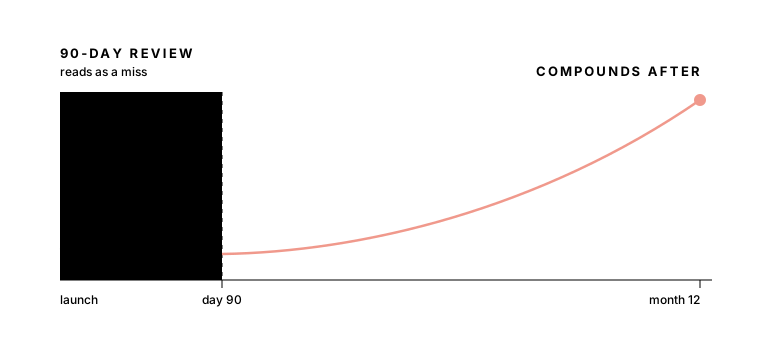
We tracked the mechanism in GA4 the whole way, because the argument for patience has to be made with evidence, not reassurance. The order rarely changes: redirect health first, then rankings, then organic entrances, and the outcome number last, because it sits at the end of the chain. Each early signal was a down payment on the outcome we had told them to wait for.
I would like to say I watched the flat months with perfect calm, having predicted them. I did not. Knowing the lag is coming does not make the dashboard easier to open, and there was a stretch where I reread our own leading indicators the way a nervous investor rereads a thesis.
The calendar delivers its verdict early
Most structural work gets judged before its mechanism has finished running. The quarterly review is not malicious; it is tuned for work whose effects are immediate, a campaign, a price change, a button moved above the fold. Point that instrument at a restructure and it will faithfully measure the dip and call it the result. That chart is on the bench with the review date handed to you: drag it across the year and one unchanged curve reads as a failure, then a wash, then a win.
The damage is bigger than one bad meeting. When correct work gets declared a miss, the organization learns the wrong lesson: that structure does not pay, and that the safer move next time is to repaint the surface and post the before-and-afters. That is how teams talk themselves out of the only kind of work that compounds.
Negotiate the window before launch
The measurement window is negotiable exactly once, before launch, while the decision to do the work is still being made. That is when to put the shape of the curve on paper and get the people who will attend the ninety-day meeting to agree to it.
- Name the dip in the plan. A flat or falling stretch that was predicted in writing reads as the mechanism working. The same stretch, unannounced, reads as failure.
- Pick leading indicators. Redirect health, recovering rankings, task success on the new structure: signals that move in weeks and predict the number that moves in quarters.
- Date the verdict. Agree on when the outcome metric will be judged, twelve months out for structural change, and hold that date as firmly as the budget.
This is experience strategy as much as measurement: deciding what the work should change, then protecting that decision through the months when the dashboard argues against it. Structural work pays. It just refuses to pay on the review calendar’s schedule, and the leaders who know that negotiate the clock before anyone touches the site map.

Director of Experience at Primacy. I find the order complex systems are missing: experience strategy, information architecture, and design systems for hospital networks, universities, and insurers.
Keep reading
- Feb 24, 2026
The tree test won an argument I couldn't
Months of recommending the same navigation change moved nobody; one tree test ended the argument in a single meeting. The difference was research designed so the losing side could concede safely.
MethodResearchLeadership4 min - Mar 19, 2026
Nobody gets promoted for deleting pages
Everyone knows which pages are dead. They stay up because publishing is rewarded and pruning is punished, and making subtraction safe is a leadership deliverable, not another audit.
PracticeContent StrategyLeadership3 min