Nobody gets promoted for deleting pages.
Everyone knows which pages are dead. They stay up because publishing is rewarded and pruning is punished, and making subtraction safe is a leadership deliverable, not another audit.
- Published
- Reading time
- 3 min
- Length
- 688 words
- Share
On a 10,000-page hospital network site, 60% of pages drew under 1% of traffic. When we put that number in front of the people who owned those pages, nobody argued with it. They already knew. The pages stayed up anyway, because knowing a page is dead and being the person who removes it are two very different positions.
Everyone already knew
The bloat was not a discovery. Ask anyone who works on a large site which sections are dead weight and they will tell you, often with specific pages in mind. What the GA4 data added was not information. It was permission: a private suspicion restated as a number that could sit in a shared document.
That distinction matters, because bloat usually gets treated as a hygiene problem, something a content audit will fix. We had inventoried all 10,000 pages and scored each one against traffic, search demand, and clinical priority. The scoring was the easy half: it told us what could go and said nothing about who would let it. The sorting itself is now a tool on the bench, Triage, because the part that kills an audit is never the judgment, it is the spreadsheet.
Publishing is rewarded, pruning is punished
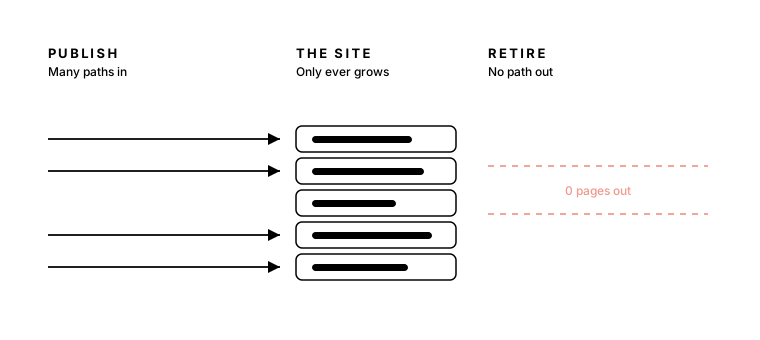
Pages accumulate because every incentive around them points the same way. A new page is a deliverable: it has a sponsor, a launch, a line in somebody’s annual review.
Retiring a page has none of that, and it carries a risk the launch never did. If anyone misses that page even once, there is a name attached to its removal.
The upside of pruning is diffuse: a cleaner site and a smaller migration bill, all of it shared. The downside is specific and personal. Nobody gets promoted for deleting pages, but you can get an angry email for deleting one, and people do that math correctly.
Every page has an internal sponsor and no internal cost. Bloat is the stable equilibrium.
Calling the site bloated implies something went wrong. Nothing went wrong. The system produced exactly what it rewards, and it will keep producing it, which is why the same cleanup gets recommissioned every few years.
Subtraction has to be made safe
Content owners let go of pages when letting go stops being a personal risk. I went in believing the traffic numbers would carry those conversations, and they carried less than I would like to admit. The number opened the door. Three other things got people through it.
- A redirect plan. Every retired URL lands somewhere better, so no path a person might still follow ever dead-ends.
- Archive access. Nothing is destroyed, only shelved, and an owner can defend a page that moved to the archive in a way they cannot defend a deletion.
- Cover from above. The retirement decision was owned above them, so a complaint would land on the initiative and not on the person.
The practical difference between deleting a page and archiving it behind a redirect is small. The political difference is the whole negotiation. Offer people the second and most of them will accept what is, functionally, the first.
Change what a page costs
The way out is to change the incentive, not to run another audit. The next audit will tell you what you already know. Give every new page a named owner and a review date at publish, so the default is expiration instead of immortality. Report retirements next to launches, so subtraction shows up where work gets noticed.
Most of all, put a senior name on the pruning decision. Making subtraction safe is a leadership deliverable, not a content task, because the risk that keeps dead pages alive never belonged to the content team in the first place. An audit will find the dead weight for you. Making it safe to let go is the part only leadership can do.

Director of Experience at Primacy. I find the order complex systems are missing: experience strategy, information architecture, and design systems for hospital networks, universities, and insurers.
Keep reading
- Dec 09, 2025
Cheap alternatives are how good decisions die
Design decisions used to be protected by the cost of producing an alternative, and AI removed that cost. If the reasoning was never written down, it is now up for grabs.
PracticeLeadershipAI4 min - Oct 21, 2025
We automated the apprenticeship
A junior on my team turned a rough brief into a polished prototype before lunch, and it worried me. The production drudgery AI just removed was where judgment formed, and that training now has to be rebuilt on purpose.
PracticeLeadershipAI4 min