On this page7 sections
You have felt it already, even if you have not named it. You open a new site, and within a second you know you have been here before. The same hero, the same gradient, the same three feature cards, the same confident sans-serif telling you to get started. Nothing is wrong with it. That is the problem.
AI did not make websites worse. It made competent ones effortless, and in doing so it raised the floor for everyone at once. When a usable, on-trend, technically sound experience can be generated in an afternoon, usable and on-trend and sound stop being achievements. They become the baseline you share with everyone else who typed a similar prompt. The differentiator moves somewhere the model does not naturally go: to whether the thing makes anyone feel anything at all.
The floor came up, and the sameness came with it
Generative tools are trained to produce the most probable next thing. Given a brief, they return the center of the distribution: the layout that usually works, the copy that usually converts, the pattern that has been rewarded a million times. That is a feature when you need a competent draft fast. It is also why so much of the AI-built web has started to rhyme. Everyone is pulling from the same center, so everyone arrives at the same place.
This is the homogenization that abundance always produces. When something becomes cheap to make, the average quality rises and the variance collapses. We are living through the design version of that: a sea of sites that are individually fine and collectively indistinguishable. Competence is no longer scarce, so competence no longer differentiates.
When everyone can produce the expected thing instantly, the expected thing is worth nothing. What is scarce is the experience someone remembers.
What emotional resonance actually means
Emotional resonance is the felt sense that an experience was made for you, by someone who cared about how it would land. It is the small surprise that makes you smile, the copy that sounds like a person and not a committee, the moment the product anticipates you so precisely it feels like recognition. It is not decoration layered on top of a working product. It is the difference between a product you use and a product you trust, return to, and tell someone about.
Don Norman gave us the structure for this two decades ago: experiences work on us at three levels at once. The visceral, our gut reaction in the first instant. The behavioral, how it feels to actually use. And the reflective, the story we tell ourselves about what using it says about who we are. AI is very good at the behavioral middle. It is the visceral first impression and the reflective afterglow, the two ends, where resonance lives and where generated work tends to go quiet.
The research was here long before the AI was
None of this is sentiment. The evidence that feeling drives perception predates the current moment by decades.
- The aesthetic-usability effect. In 1995, researchers Masaaki Kurosu and Kaori Kashimura found that people rated more beautiful interfaces as easier to use, even when they were not. Noam Tractinsky later replicated it across cultures. Emotion does not sit beside usability; it colors the entire judgment of it.
- The peak-end rule. Daniel Kahneman’s work showed that we judge an experience not by its average but by its most intense moment and its ending. Design the peak and the last beat with care and the whole memory bends positive. Leave them to the default and the experience evaporates the moment it is over.
- The hierarchy of user needs. Aarron Walter mapped the path from functional to reliable to usable to pleasurable, arguing that delight is the top of the pyramid, not a nice-to-have. AI has made the bottom three nearly automatic. The top one is still ours.
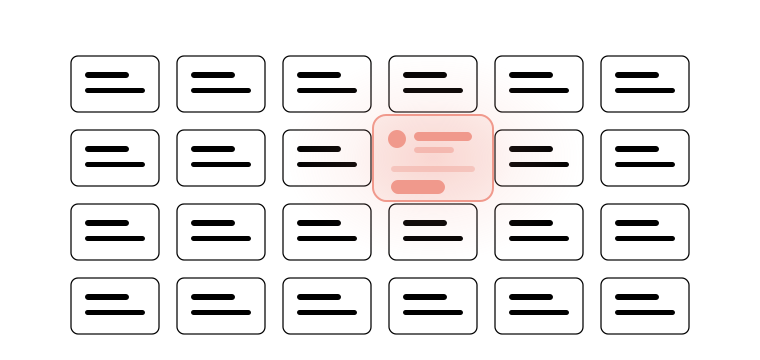
Why sameness is the default, and resonance is a choice
A model regresses toward the mean because the mean is what it was rewarded for. Emotion lives at the edges: in the specific detail, the unexpected turn, the particular voice that no average would ever produce. Resonance is, almost by definition, the thing the most-probable output leaves out.
That is not an argument against the tools. I build with them every day, and they are the fastest way to a competent foundation we have ever had. It is an argument about where the human judgment now has to go. When the tool hands you the center of the distribution for free, your job is no longer to reach competence. It is to decide, deliberately, where this experience will depart from the expected in a way someone will feel.
Designing for resonance on purpose
If feeling is the differentiator, then it has to be a deliberate part of the work, not a happy accident at the end. A few of the moves that consistently matter:
- Anchor to a real emotional job. People do not adopt products to complete tasks; they adopt them to feel competent, in control, relieved, proud. Name the feeling you are designing for before you design the screen, and the screen has something to aim at.
- Design the peak and the end. Find the one moment that should land hardest, the first success, the result, the goodbye, and spend disproportionate care there. The middle can be efficient. The edges are what people keep.
- Let a point of view show. A specific voice, an opinionated default, a detail that could only have come from your team. The particular is what a generic model cannot reproduce, which is exactly why it reads as human.
- Sweat the small, felt details. The easing on a transition, the honesty of an empty state, the warmth of an error message. Individually invisible, together they are the entire difference between fine and trusted.
What this means for being found, not just felt
Here is the part that makes resonance a strategy and not just a craft value. The same homogenization is happening in how people discover anything. Search results, social feeds, and now AI-generated answers are all a wall of competent sameness, and both the algorithms and the humans behind them are deciding what to surface, cite, and remember.
Generative engine optimization, the practice of earning a place in AI-written answers, rewards the same thing emotional design does: a distinct, well-formed point of view. Models cite the source that says something specific and quotable, not the tenth restatement of the consensus. People click and return for the experience that felt like something, not the one that felt like everything else. Distinctiveness is now doing double duty. The thing that makes an experience resonate with a person is increasingly the thing that makes it legible to a machine deciding what is worth pointing to.
We are all new at this
I want to be honest about the altitude of all of this. Nobody has ten years of experience designing for a world where competence is free, because that world is about a year old. The patterns are still forming. The best practices are being written in public, by all of us, in real time, and a good portion of what feels certain today will look naive by next year.
But the underlying bet feels durable. As the cost of making something competent falls to zero, the value of making something felt rises to meet it. The tools will keep getting better at the expected. Our job, the part that does not automate, is the unexpected, human, resonant thing on top. That has always been the real work of design. AI just removed everywhere else it could hide.

Director of Experience at Primacy. I find the order complex systems are missing: experience strategy, information architecture, and design systems for hospital networks, universities, and insurers.
Keep reading
- Jul 20, 2026
I stopped renting my portfolio
Squarespace, Adobe Portfolio, Framer, Webflow, Nextra: five rented portfolios in, my site still didn't feel like mine. So I built the sixth by hand.
PracticeCraftAI6 min - Jul 23, 2026
Your next applicant asked ChatGPT first
Nearly half of college-bound students now ask AI before they ask you, and one in five has already crossed a school off because of an answer.
StrategyHigher EdAI6 min