Polish is no longer evidence of thinking.
Reviews approve finished-looking work because finish used to mean effort. AI made finish free, and the instinct that reads polish as rigor is now approving hollow work it cannot feel.
- Published
- Reading time
- 4 min
- Length
- 817 words
- Share
The deck arrives in review looking finished. Clean type, a coherent system of diagrams, headings that sound like conclusions. Heads nod, questions drift to timeline, and approval happens almost on its own. I have watched that meeting go the same way for most of my career, and I trusted it, because for most of my career the look of finish meant something.
The signal is gone and the room has not noticed. Polish was evidence of effort, effort was a rough proxy for thinking, and AI severed the first link in that chain while every approval ritual keeps behaving as if it holds.
Fluency feels like rigor
People trust what is easy to process. Behavioral science calls it processing fluency: whatever is easy to perceive, read, or follow gets judged as more true, more likable, and better made. Reber and Schwarz demonstrated it with something as small as legibility, where the same statement in an easier-to-read format is rated more likely to be true.
Design has its own version of the bias. In 1995, Kurosu and Kashimura tested ATM layouts and found that ratings of how usable an interface looked tracked its attractiveness, not its actual performance. People read beauty as competence before deliberation gets a vote.
I spent a year in a visual-perception research lab before I ever led research on client work, and the detail that stays with me is where this bias lives. It is not a reasoning error you can catch yourself committing. It fires upstream, in perception, before the part of you doing the reviewing has anything to review.
Polish was an honest proxy
For decades, judging work by its finish was reasonable. A typeset deck with considered diagrams implied dozens of hours, and dozens of hours implied that someone had lived with the problem long enough to think about it. Economists have a name for that kind of evidence: a costly signal, trustworthy precisely because it is expensive to fake.
So organizations never built rituals for evaluating thinking directly. They built rituals for detecting effort and inferred the thinking from it. The signoff meeting, the review gate, the executive read-through: all of them calibrated, quietly, on surface finish, because finish was the most reliable instrument in the room.
Polish was a costly signal of effort. AI turned it into a free signal of nothing.
The proxy has been counterfeited at scale
A signal that costs nothing to produce carries no information, and finish now costs close to nothing. I build with AI every day, and I can reach a surface before lunch that would have passed any review I sat in five years ago. The thinking still takes what it always took. It just no longer travels with the finish, which is the only place most reviews ever looked for it.
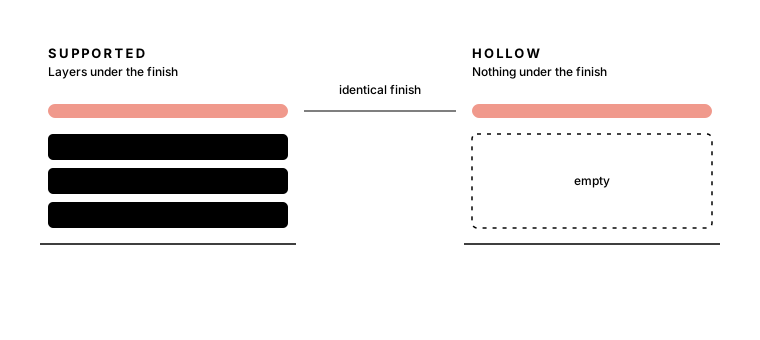
This is why “stakeholders approve AI drafts too fast” is the wrong diagnosis. Nobody in the room got less disciplined. The gate is running the same perceptual shortcut it always ran; the shortcut just stopped pointing at anything. A review calibrated on fluency will approve fluent emptiness all day, and the research says the people at the gate will not feel it happening.
Review the thinking, not the finish
The fix is not to distrust polished work. It is to stop letting the finish speak on the work’s behalf. On my team we have started adding deliberate friction before AI-assisted work reaches review, so the reasoning has to show up on its own.
- State the frame first. Before anything goes on screen, the author says in plain words what problem this solves and for whom. If that sentence is fuzzy, the finish was hiding it.
- Show the losing options. Real judgment leaves behind alternatives that were considered and rejected. Ask to see them. Generated work rarely has any.
- Read it ugly. At least one pass happens on unstyled text. What survives without the typography is the argument. Sometimes nothing does.
I want to be honest about how new this is. We are inventing these checks as we go, and I do not yet know which of them measure thinking and which just measure a different kind of performance. Nobody has review instincts calibrated for a world where finish is free. Mine included.
Start with the next thing you are asked to approve. Keep the artifact off the screen for ten minutes and ask what problem it solves, which alternatives lost, and what evidence carried the choice. Strong answers make the polish a bonus. Weak ones tell you exactly what the finish was hiding.

Director of Experience at Primacy. I find the order complex systems are missing: experience strategy, information architecture, and design systems for hospital networks, universities, and insurers.
Keep reading
- Jul 23, 2026
Your next applicant asked ChatGPT first
Nearly half of college-bound students now ask AI before they ask you, and one in five has already crossed a school off because of an answer.
StrategyHigher EdAI6 min - Jun 19, 2026
Emotional resonance is the differentiator
AI can generate a competent website in minutes, which is exactly why competence no longer sets work apart. What stands out now is whether the experience makes anyone feel something.
StrategyAICraft7 min