The tree test won an argument I couldn't.
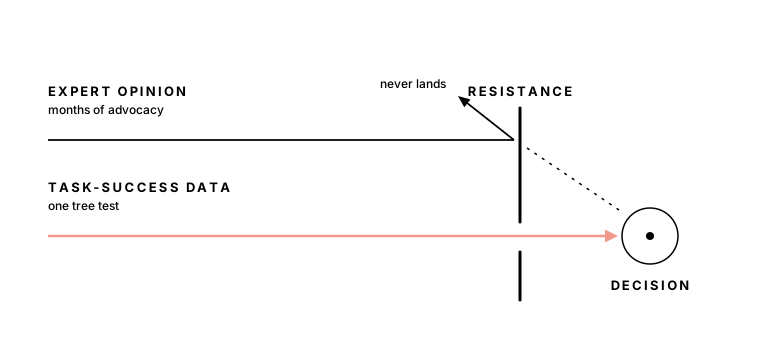
Months of recommending the same navigation change moved nobody; one tree test ended the argument in a single meeting. The difference was research designed so the losing side could concede safely.
- Published
- Reading time
- 4 min
- Length
- 779 words
- Share
For months I made the same recommendation to the same dozen service-line owners at a hospital network, and for months it went nowhere. Patients look for care by condition and body part, not by the department that treats them, so the navigation should follow. I had the reasoning, the precedent, and a deck that kept getting sharper. None of it moved a single person in the room.
Then we ran a tree test, and the argument ended in one meeting. The finding had not changed. It was the same conclusion in a different form, and the form turned out to be the whole fight. If you have never sat on the other side of one, the method is playable here.
The recommendation was the problem
My recommendation kept failing because of what it was, not what it said. Delivered as expert judgment, the finding arrived with an author attached, and the author was the person asking a dozen owners to move their front doors. Rejecting it felt less like ignoring evidence than like holding ground in a negotiation.
Psychologists call this motivated reasoning: we hold evidence to a stricter standard when we cannot afford its conclusion. Everyone in that room had something real to lose, so every version of my argument met the strictest standard available. Repetition made it worse. By the tenth telling, the recommendation had hardened from a finding into my position.
What the tree test changed
The tree test took me out of the argument. The artifact in the next meeting was a set of Optimal Workshop task-success results, not a recommendation: real people trying to find care in the structure the owners had spent months defending, and failing in ways nobody could file under designer opinion. There was no author to push back on. There was only what people did.
Nobody was being asked to admit I was right anymore. They were watching their own patients fail to find them. Conceding to a colleague would have cost them status in that room; conceding to their own patients cost nothing, and every owner at the table found their way there before the meeting ended.
Research changes minds when it is designed so the losing side can concede without losing face.
Concession is a design problem
Most research is designed to inform the team that runs it, not to let a specific person, in a specific meeting, change their position safely. When stakeholders shrug off findings, teams diagnose a communication problem and build a better deck, but the deck was never the obstacle; the cost of conceding was.
Looking back at what the tree test did that my recommendation could not, three things stand out.
- The data had no author. A task-success result is not a point of view, so there was no one to negotiate with and nothing to win by holding out.
- The behavior carried the argument. Watching people fail to find care ends the debate about whether they can.
- The concession came with a cover story. “We followed the patients” is a position an owner can defend to their own team; “the consultant wore us down” is not.
I would like to say I chose the method for those reasons. I did not. I ran the tree test because months of recommending had left me out of moves, and the lesson only became clear on the way through: the study was doing persuasion work the argument never could.
Design the study for the room
Before choosing a method, name the person who has to move and count what moving will cost them. If the cost is status, an expert recommendation is the weakest instrument available, because it hands them an author to resist instead of behavior to follow. Reach for the method that removes you from the finding: task success over critique, what people did over what you think.
Moving a decision through a dozen owners is leadership work, and the study you choose is part of how that work gets done. The patients were real, the tasks were real, and the structure genuinely failed them; the method just let everyone see it from the same side of the table. That is what organizational research is for. Not to prove you right, but to make changing course the safest position in the room.

Director of Experience at Primacy. I find the order complex systems are missing: experience strategy, information architecture, and design systems for hospital networks, universities, and insurers.
Keep reading
- Apr 14, 2026
Good work looks like failure at 90 days
Structural work pays off on a lag, as search re-indexes and habits re-form long after the quarterly review has rendered its verdict. Negotiate the measurement window before launch.
StrategyResearchLeadership4 min - Mar 19, 2026
Nobody gets promoted for deleting pages
Everyone knows which pages are dead. They stay up because publishing is rewarded and pruning is punished, and making subtraction safe is a leadership deliverable, not another audit.
PracticeContent StrategyLeadership3 min