Users don't know where your website ends.
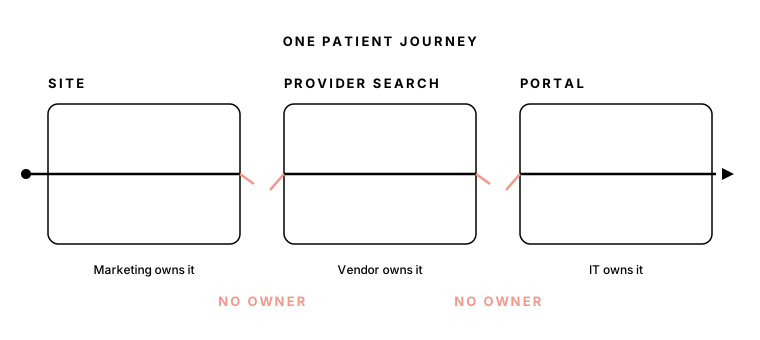
A patient books care in one continuous motion across three systems owned by three teams. The worst failures live in the seams between them, and nobody is accountable for a seam.
- Published
- Reading time
- 4 min
- Length
- 786 words
- Share
Watch a patient book an appointment online and you will see one continuous motion. She finds a cardiologist on the hospital’s site, checks availability, picks a Tuesday slot, and logs in to confirm. Ask her where the website ended and the scheduling system began, and you will get a blank look. It was all just the hospital.
Inside the organization, that same motion crossed three products from three vendors: the marketing site in the CMS, provider search running on Kyruus, scheduling inside Epic’s MyChart. Three contracts, three roadmaps, three teams that meet a few times a year. The patient took one journey through a place that, organizationally, does not exist.
The failure lives in the seams
Low booking conversion is rarely a page problem. I have spent enough time inside hospital-network booking flows, wiring sites into Kyruus and MyChart, to know where the drop-off actually collects. It is not on the pages each team polishes. It is at the handoffs no team can see whole.
- The identity break. The type and colors shift and the header disappears. At the exact moment a patient commits, the environment stops looking like the hospital she chose.
- The memory break. The location she picked and the insurance she entered do not survive the handoff, so the next system asks again for everything she already gave.
- The login wall. Credentials get demanded at the moment of highest intent, and a forgotten portal password quietly ends more booking journeys than any page design ever will.
Each of those failures is invisible from inside any single system. The site did its job, the search did its job, the portal did its job. The journey still died.
Patients experience one continuous journey. The organization ships three systems and hopes the seams hold.
Your org chart is printed on the journey
Experiences break exactly where team boundaries sit, and that is not a coincidence. In 1968, Melvin Conway observed that organizations produce designs that copy their own communication structures. Three teams that rarely talk will ship three experiences that barely connect.
You can hear it in the meetings. Someone eventually says “that’s an Epic limitation,” and sometimes it is. More often it is a boundary limitation: the fix needs two teams, two budgets, and a decision nobody in the room is authorized to make, so it gets filed as a platform constraint and the agenda moves on.
Every dashboard is green while the journey fails
Page analytics cannot see a journey failure. Each system reports on itself, and each report stops at its own edge: site engagement is healthy, portal uptime is excellent, so nobody looks harder. The failure lives in the space between the reports, which is precisely the space no report covers.
It took me longer than I want to admit to see this, because I was reading the same siloed reports as everyone else. The funnel that matters, the one that follows a person from symptom search to confirmed appointment, crosses every boundary and lives in none of them, so nobody builds it. Until someone assembles that view by hand, you cannot even name where the journey is dying.
So we started reading outcomes at the journey level instead. On one hospital-network engagement, online booking starts rose 40%, organic, in the year after launch, and that gain sat on no single page and in no single system. It showed up only in the funnel that follows a person the whole way, which is the only level a patient ever experiences.
Someone has to own the handoff
Start by naming the seams, because nobody fixes what nobody owns. Walk your own booking flow the way a patient would, on a phone, logged out, starting from a symptom search. Write down every point where the system changes underneath you, then check who owns each handoff. The honest answer is usually no one.
Then assign every seam a single owner with the standing to convene both sides, and measure the journey end to end rather than the pages one at a time. This is unglamorous work, and it is the actual job.
Experience strategy at the director level is mostly claiming the problems that sit between other people’s responsibilities. The vendors will not claim them, because each is contractually correct to stop at its own edge. So the seams sit unowned until someone decides the whole journey is theirs to answer for.

Director of Experience at Primacy. I find the order complex systems are missing: experience strategy, information architecture, and design systems for hospital networks, universities, and insurers.
Keep reading
- Jul 19, 2026
Left navigation isn't faster, it's first
A controlled study moved the menu to the right and nobody slowed down. The side you pick doesn't set speed; it sets whether a visitor meets navigation or content first.
StrategyInformation ArchitectureUX8 min - Jul 08, 2026
Nobody is searching for otolaryngology
Patients search by symptom, condition, and body part. Hospital sites answer in the language of departments, so every marketing dollar drives traffic into a vocabulary wall the navigation built.
StrategyHealthcareInformation Architecture4 min