We automated the apprenticeship.
A junior on my team turned a rough brief into a polished prototype before lunch, and it worried me. The production drudgery AI just removed was where judgment formed, and that training now has to be rebuilt on purpose.
- Published
- Reading time
- 4 min
- Length
- 770 words
- Share
A junior designer on my team took a rough brief at nine in the morning and had a working, polished prototype before lunch. States handled, type set with care. Two years ago that task was a week of production drudgery, and most of it would have come back covered in corrections. This one needed almost none, and that is what worried me.
Every design leader I talk to is carrying a version of the same complaint: juniors aren’t ready and the next seniors are not arriving on schedule. The complaint blames the talent. I think the cause is structural, and that we built it ourselves.
Production was the apprenticeship
Production work was never just output. It was how judgment formed, one correction at a time, and nobody had to design it that way.
For decades the deal was implicit. Juniors did the tedious making: the third revision of a flow, the spacing pass at the end of a sprint. In exchange they collected corrections, one senior red-line at a time.
Any single correction is trivial. A label renamed, a step cut, a screen rebuilt because the first version buried the thing people came for. What a few thousand of them leave behind is judgment.
This is the mechanism Ericsson spent a career documenting as deliberate practice: tasks just past your current ability, immediate feedback, and repetition until the correction becomes how you see. Ericsson’s own point was that ordinary experience supplies none of these reliably. Production work with a senior red-lining every file was the exception: it supplied all three by accident, because the apprenticeship was indistinguishable from the billable work.
The correction loop went missing
AI now does the work juniors used to learn on. A competent first draft costs almost nothing today, which is wonderful for a delivery schedule and quietly expensive for a career.
The junior designers on my team no longer build that third revision by hand. The tools we use daily produce it, and produce it well. What disappeared with the tedium was everything riding along with it: the red-lines and the rebuilds that used to compound into taste.
The expectations did not move. We still expect juniors to become seniors in roughly the same number of years, still expect judgment to arrive on schedule. It is not coming that way anymore.
We removed the training ground and kept the expectations.
Practice is now something I assign
The replacement for an accidental apprenticeship is a deliberate one. On my team, growing judgment is now a planned piece of leadership work, because it no longer happens on its own. I build alongside the team every day, and most of what has changed is small.
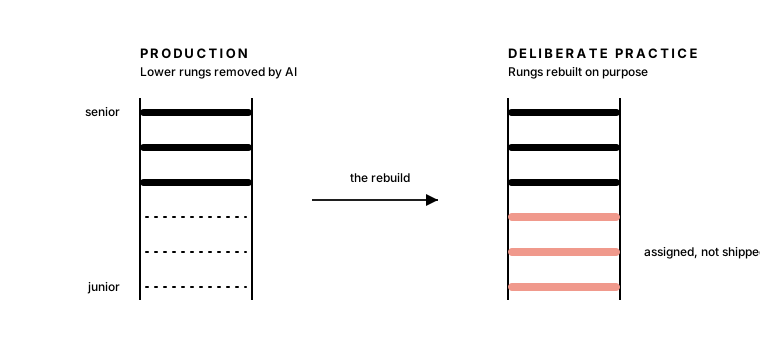
- Some work still gets done by hand. Not because the tools couldn’t do it, but because the designer needs the reps. When I assign it, I say out loud that the correction is the point.
- We tear down machine output together. Fluent work hides its flaws. Saying precisely what is wrong with a finished-looking draft is harder than fixing a rough one, and it is the closest substitute I have found for the old red-line loop.
- The reasoning gets narrated. When I overrule a decision, I explain why in front of the work, the way corrections used to arrive in the margins of a junior’s file.
I should be honest about the evidence for this part: there is none yet. Nobody has run this experiment before, and the first designers trained this way are still years from senior. I will not know for a while whether rungs built on purpose carry the same weight as rungs that came with the job.
Rebuild the rungs on purpose
Start with an inventory, not a policy. List what your junior designers no longer do by hand, and ask what each item used to teach. Some of it taught nothing and deserves to stay gone. The rest needs a deliberate replacement: assigned reps and narrated corrections, work done slowly on purpose in a week when everything else moves fast.
None of this shows up in a velocity metric, which is exactly why it gets skipped by default. Decide, in writing, whose job the rungs are now.

Director of Experience at Primacy. I find the order complex systems are missing: experience strategy, information architecture, and design systems for hospital networks, universities, and insurers.
Keep reading
- Dec 09, 2025
Cheap alternatives are how good decisions die
Design decisions used to be protected by the cost of producing an alternative, and AI removed that cost. If the reasoning was never written down, it is now up for grabs.
PracticeLeadershipAI4 min - Sep 19, 2026
UX will outlive its job title
The job of understanding people and shaping what they meet has outlived four titles. It will outlive this one too, with less drawing and more deciding in it.
PracticeUXAI7 min