Designing for cognitive load.
Most products do not fail because they lack features. They fail because they ask people to think too hard about the wrong things. A working method for spending attention deliberately.
- Published
- Reading time
- 3 min
- Length
- 643 words
- Share
Every screen makes a quiet request of the person in front of it: hold this in your head, decide between these, remember what you did three steps ago. Those requests add up. When they add up faster than the value does, people leave, and they rarely tell you why.
I have come to treat attention as the real budget of any experience. Not clicks, not time on page, attention. It is finite, it is spent whether or not you plan for it, and the teams that win are the ones who decide where it goes on purpose.
The cost of an unclear path
Cognitive load is the mental effort a task demands. Some of it is unavoidable: the problem itself is hard. But a surprising amount is manufactured by the interface: redundant choices, inconsistent language, state the person has to reconstruct because the system forgot it for them.
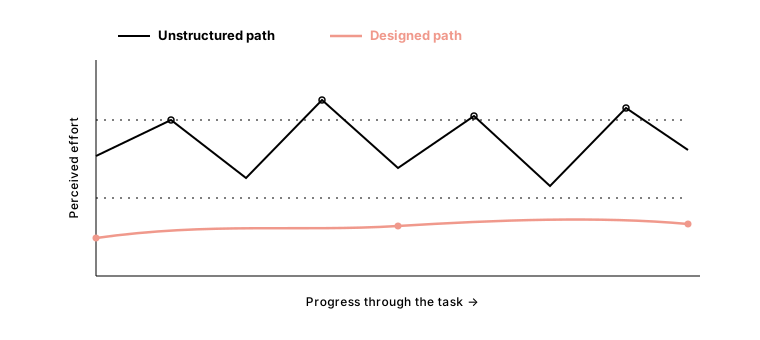
The trap is that this cost is invisible in most analytics. A confusing flow and a clear one can produce the same conversion number while feeling completely different to use. One leaves people confident; the other leaves them tired and quietly less likely to come back.
When usability is table stakes, the differentiator is not whether someone can finish the task. It is how much of themselves they had to spend to do it.
That is why I start engagements by mapping effort, not screens. Where does the path spike? Where is someone asked to make a decision they have no basis to make yet? Those spikes are where good products are won or lost.
Three ways to lighten the load
Once you can see where attention is being spent, the moves are surprisingly consistent across products and industries.
- Sequence the decisions. Ask for one thing at a time, in the order a person actually thinks about it. A long form split into a clear sequence is not slower; it feels lighter because each step is small enough to hold.
- Default the reversible. Every choice you can make on someone’s behalf, and safely let them undo, is a choice they do not have to spend attention on. Reserve real decisions for the ones that matter.
- Keep the language still. A feature called three different names across three screens forces a silent translation each time. Consistent words are not a copy detail; they are a load-bearing part of the architecture.
A note on progressive disclosure
The instinct to “just show everything” comes from a good place (transparency), but it shifts the cost of filtering onto the user. Progressive disclosure flips that: surface the essential, make the rest reachable, defer what almost no one needs. Done well, it is invisible. People simply feel like the product anticipated them.
What this looks like in practice
On a recent platform with a sprawling navigation, the brief was “add a mega-menu.” The real problem was that the information architecture asked people to know the company’s org chart to find anything. We did not add a richer menu; we re-grouped the entire structure around the handful of jobs people actually came to do. The menu got smaller. Task completion went up. The work that mattered happened in the model underneath, not the surface on top.
That is the pattern, almost every time. The visible fix and the real fix are rarely the same. Cognitive load gives you a way to tell them apart, and a way to argue for the harder, quieter work that actually moves the experience.
Spend attention like it costs something. It does.

Director of Experience at Primacy. I find the order complex systems are missing: experience strategy, information architecture, and design systems for hospital networks, universities, and insurers.
Keep reading
- Sep 19, 2026
UX will outlive its job title
The job of understanding people and shaping what they meet has outlived four titles. It will outlive this one too, with less drawing and more deciding in it.
PracticeUXAI7 min - Jul 19, 2026
Left navigation isn't faster, it's first
A controlled study moved the menu to the right and nobody slowed down. The side you pick doesn't set speed; it sets whether a visitor meets navigation or content first.
StrategyInformation ArchitectureUX8 min