A high school junior opens ChatGPT at the kitchen table and types a question her parents would have asked a guidance counselor: which schools near Boston have strong nursing programs that won’t bury me in debt? The answer names four universities, with tuition figures, licensure pass rates, and a sentence each about clinical placements. It reads like advice from someone who did the homework.
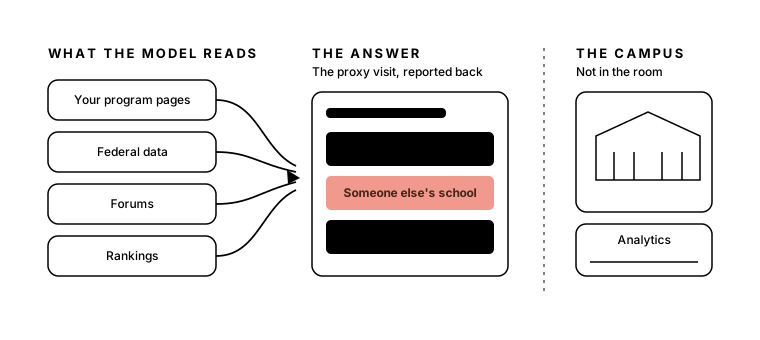
Your school is not one of the four. No page was loaded, so nothing shows in your analytics. Admissions never learns the question was asked. The first visit happened, the impression formed, the list narrowed, and your institution was not in the room.
The search moved, and it did not send a notice
The numbers on this are no longer speculative. In a national survey of more than five thousand high school students released this February, EAB found that 46 percent now use AI tools like ChatGPT in their college search, up from 26 percent in the previous spring’s survey. Nearly one in five, 18 percent, had already removed a college from consideration because of something an AI answer told them. Most of those schools will never know they were evaluated.
The broader pattern is the same. SparkToro’s analysis of Similarweb clickstream data found that 68 percent of U.S. Google searches in early 2026 ended without a click on any result. The question got answered on the results page or in an AI summary, and the visit that used to follow never happened.
Enrollment teams have spent two decades reading the funnel through analytics: sessions, program-page views, RFI submissions. That instrument panel still works. It just no longer covers the top of the funnel, because the top of the funnel moved into a conversation you cannot see.
The proxy visit
I think of an AI answer about your institution as a proxy visit. The student never comes to campus, never opens your site. A model tours on her behalf, assembles an impression from whatever it can read, and reports back in a paragraph.
What does it read? Your program pages, if they parse cleanly. Federal data like the College Scorecard. Rankings. Reddit threads written by students you graduated and students you rejected. Where your site is vague, the model does not pause the way a person might; it fills the gap from whichever source speaks plainly, and it presents the result with the same even confidence either way.
When your program page won’t state the cost, the model asks Reddit, and Reddit always answers.
I wrote recently that the university homepage is a treaty negotiated by internal powers, with prospective students absent from the room. The proxy visit is that problem at one remove. Now even the room is gone. There is no meeting where you can lobby for placement, no layout to fight over. There is only the question, the sources, and whether your institution’s facts were legible when the model came through.
This is an architecture problem in a marketing costume
The reflex response is to treat AI visibility as a new marketing specialty, and vendors are already selling it that way. Most of what they sell is a costume. Run enough of these answers to their sources and the pattern is unglamorous: models break pages into chunks and lift the sections that answer one question directly, with real numbers, under a heading that says what it is. Stable program names. Facts stated in text rather than buried in a PDF viewbook or rendered inside an image.
Read that list again and it is an information architecture brief. One page per question. Say the cost. Name the program what students call it, not what the faculty senate calls it. This is the same top-task discipline that IA has demanded for twenty years, applied to a new and strangely literal reader.
The literal part matters. A seventeen-year-old skims your program page and gives up when the tuition is three clicks away; the model does the same thing faster and at scale, on behalf of thousands of her. I have spent a decade restructuring university sites around the questions applicants actually ask, most recently rebuilding a university’s program architecture page by page. The work that makes a site answer well for an anxious junior is the same work that makes it citable by the machine touring for her. There is no separate AI version of clarity.
Run the proxy visit yourself
You do not need a vendor to find out how you tour. Open a model with web access and ask, on behalf of a student, the five questions that decide real lists:
- What does your flagship undergraduate program actually cost per year?
- What are my chances of getting in with a given GPA and no test scores?
- What jobs and salaries do graduates of that program get?
- How does the program compare with the same program at your closest rival?
- What are the application deadlines and requirements this cycle?
Then score the answers the way an enrollment VP would. Were you named at all? Were the numbers right, and current? And look at the citations: whose pages did the model lean on, yours or a forum’s?
Where the tour goes wrong, the fixes are structural, not promotional:
- Give every recurring question one authoritative page. Cost, outcomes, deadlines, aid. A model lifts self-contained answers; it cannot lift an answer scattered across six pages and a PDF.
- Put the numbers in text. Tuition tables rendered as images, viewbook PDFs, and “contact us for details” are all invisible or worse. State the figure in a sentence and keep it current.
- Hold program names stable. If the site says Human Performance Science and every student on earth searches nursing, the model will not make the connection reliably, and naming is an evidence question, not a branding one.
- Keep the structured data honest. Schema markup for programs, costs, and FAQs is the machine-readable map of the site. It is plumbing, and it is cheap, and it removes the ambiguity that keeps a machine from trusting your numbers.
None of this shows up in a campaign dashboard, which is why it keeps losing budget fights to things that do. But the proxy visit is already how a growing share of your applicant pool meets you, and it runs on the oldest test in this field: can the question find its answer? For ten years the reader failing that test was a person. Now a second reader fails it for thousands of people at a time, silently, before you know they exist.

Director of Experience at Primacy. I find the order complex systems are missing: experience strategy, information architecture, and design systems for hospital networks, universities, and insurers.
Keep reading
- Jun 28, 2026
The university homepage is a treaty, not a front door
Every university homepage is cluttered in the same way, and the reason is not design. The space is divided by internal seniority, not visitor need, and no layout fixes a negotiation.
StrategyHigher EdInformation Architecture5 min - Jun 19, 2026
Emotional resonance is the differentiator
AI can generate a competent website in minutes, which is exactly why competence no longer sets work apart. What stands out now is whether the experience makes anyone feel something.
StrategyAICraft7 min