Most redesigns are reorganizations.
When a product feels broken, the instinct is to redesign the surface. Usually the problem is underneath, in how the thing is organized. The fix is structure, not paint.
- Published
- Reading time
- 3 min
- Length
- 654 words
- Share
Most requests for a redesign are not really about design. Someone says the site feels dated, or cluttered, or hard to use, and the assumed fix is a new look: cleaner type, a fresh palette, a modern component set. But when you trace the actual complaint back to its source, it usually lands somewhere else. The thing is not ugly. It is disorganized. People cannot find what they need, cannot tell two options apart, cannot predict where a link will take them. That is not a paint problem. It is a structure problem, and you cannot style your way out of it.
The surface gets the blame
Structure is invisible when it works and invisible when it fails. What people see is the surface, so the surface is what they point at. A confusing menu reads as “bad design.” A page that buries the one thing you came for reads as “cluttered.” The vocabulary people reach for is visual, even when the cause is not.
So teams redesign the surface. They ship a cleaner version of the same bad structure, and for a few weeks it feels better because it is new. Then the same complaints come back, because the thing that was actually wrong was never touched.
You can make a confusing structure prettier. You cannot make it clear.
What a redesign usually changes
Look closely at the redesigns that actually work, and most of the important moves are reorganizations. The visible style is downstream.
- What is grouped with what. Related things sit together; unrelated things stop pretending to belong.
- What things are called. One name per concept, in the user’s language, used consistently everywhere.
- What order things come in. The sequence matches how someone actually thinks about the task, not how the company is structured internally.
- What gets left out. The bravest structural move is usually subtraction: the options that existed to satisfy an internal stakeholder, not a user.
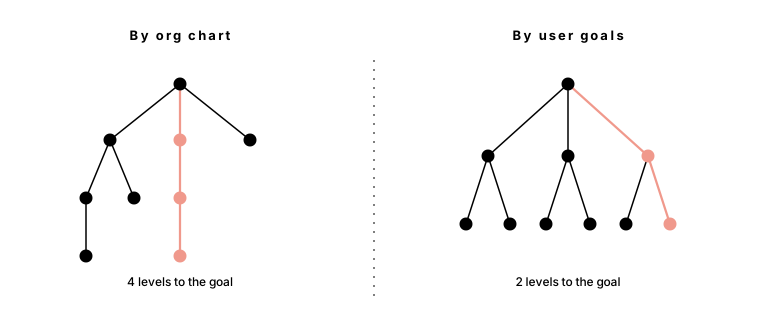
None of those are visual decisions. You could execute every one of them in plain, unstyled HTML and the product would already be better. The new look is the reward for getting the structure right, not the cause of the improvement.
Why structure is the hard part
Structure is hard for reasons that have little to do with craft. A site map is a map of an organization’s politics. Every team wants its thing in the top navigation; every stakeholder has a concept they consider essential. Reorganizing means telling some of those people that their thing is not where the user expects it. That is a harder conversation than choosing a typeface, which is exactly why it gets avoided in favor of one.
Start with the structure
Before anyone opens a design tool, get the structure right on paper. Group the content the way a user would, not the way the company is organized. Name things in their words. Map the path to the handful of tasks people actually come to do, and count the steps. If that structure is sound, almost any competent visual treatment will feel clear. If it is not, no amount of polish will save it.
Structure is cheap to change while it is still an outline and expensive to change once it is built. Cheap enough that I built a tool that draws the outline and tells you which sections are already too crowded to scan. Spend the disagreement early, on the organization of the thing, where it costs the least and matters the most.

Director of Experience at Primacy. I find the order complex systems are missing: experience strategy, information architecture, and design systems for hospital networks, universities, and insurers.
Keep reading
- Jul 19, 2026
Left navigation isn't faster, it's first
A controlled study moved the menu to the right and nobody slowed down. The side you pick doesn't set speed; it sets whether a visitor meets navigation or content first.
StrategyInformation ArchitectureUX8 min - Jul 08, 2026
Nobody is searching for otolaryngology
Patients search by symptom, condition, and body part. Hospital sites answer in the language of departments, so every marketing dollar drives traffic into a vocabulary wall the navigation built.
StrategyHealthcareInformation Architecture4 min