The prototype is the spec.
Forward-thinking teams are trading static, text-heavy PRDs for working, clickable prototypes built fast with AI. The spec is becoming something you use, not something you read.
- Published
- Reading time
- 4 min
- Length
- 749 words
- Share
For years the product requirements document was where an idea became official. You wrote down what to build, everyone signed off, and engineering went to work. The document was the contract and the source of truth. It was also, almost always, wrong in ways no one could see until the product existed.
That is changing. The artifact everyone signs off on is shifting from a document you read to a prototype you can open and use: a functional, clickable slice of the product, built in hours with AI rather than described across pages. The shift is not cosmetic. It changes what the spec even is.
The PRD was always a proxy
A requirements document is a description of a thing you cannot build yet. That was its whole reason to exist. Software was expensive and slow to make, so teams argued about a cheaper stand-in first. The words were never the point; shared understanding was the point, and the document was the best proxy we had for it.
The trouble with proxies is that they leak. Every reader builds a slightly different product in their head from the same paragraph. A sentence that feels precise to the person who wrote it is ambiguous to the person who has to build it. By the time those gaps surface, they are expensive to close.
A document is read and interpreted. A prototype is used. One produces opinions about the words; the other produces reactions to the thing.
Prototyping moved into code
Prototyping itself has moved on. Where this work once lived as static mockups and lightly wired click-throughs, more of it is now built in real code. AI has made it fast enough that building a thin version of the actual product is often quicker than describing it well. The Lab is that argument run on myself.
The output is not a picture of the product. It is a working slice of it: responsive, interactive, meant to be experienced rather than looked at. That difference matters more than it sounds. A mockup shows you a screen. A coded prototype lets you tab through the form, hit the empty state, feel the latency, and notice that the flow has one step too many. You learn the things that only show up when something actually runs.
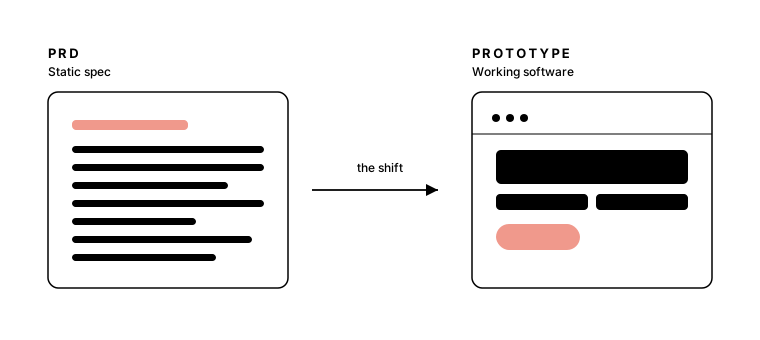
What you get when the spec is clickable
When the spec is something people use instead of read, several things change at once.
- Shared understanding arrives faster. Ten people who click the same prototype converge on the same product. Ten people who read the same PRD do not.
- The expensive errors surface early. The awkward flow, the missing state, the step that makes no sense, all of it shows up while it is still cheap to change.
- Feedback gets concrete. “This feels slow here” and “I expected this button to do something else” are more useful than line edits on a requirements doc.
- Decisions sit on evidence. You react to the real thing, early, instead of negotiating over a description of it.
Where words still earn their place
This is not the end of writing things down. A prototype is poor at some things a document is good at: the constraints, the non-functional requirements, the edge cases no one will think to click, the reasoning behind a decision. The shift is not “stop writing.” It is “stop writing the part the prototype can show, and write only the part it cannot.”
How to make the shift
You do not need to abandon your process to start. Pick the riskiest flow in the next thing you are building, the part most likely to be misunderstood, and build a thin working version of it before you write the doc. Put it in front of the people who would have read the PRD. Watch what they do, not what they say. Then write down only what the prototype could not show you: the rules, the limits, the reasons.
The PRD is not dead. It is getting smaller, because the most important part of it is no longer text. It is something you can open and use.

Director of Experience at Primacy. I find the order complex systems are missing: experience strategy, information architecture, and design systems for hospital networks, universities, and insurers.
Keep reading
- Sep 19, 2026
UX will outlive its job title
The job of understanding people and shaping what they meet has outlived four titles. It will outlive this one too, with less drawing and more deciding in it.
PracticeUXAI7 min - Jul 20, 2026
I stopped renting my portfolio
Squarespace, Adobe Portfolio, Framer, Webflow, Nextra: five rented portfolios in, my site still didn't feel like mine. So I built the sixth by hand.
PracticeCraftAI6 min