The question comes up in almost every conversation I have with someone early in their career now, and it is usually asked quietly, as if saying it out loud might make it true: is UX still going to be a job in ten years?
Yes. But the honest version of that answer has an asterisk on it, and the asterisk is the whole story. The work will be around. The title probably will not, and the part of the job most people were hired into is the part that is disappearing first.
The title has already died four times
The work this field does has been renamed roughly once a decade for as long as it has existed. In the eighties the software version of the job was called human factors, then usability engineering. In the nineties it was information architecture and interaction design, and Don Norman put “user experience” in his title at Apple in 1993 because none of the existing labels covered what he was doing. UX went mainstream in the 2000s. Somewhere in the last ten years the industry started saying “product designer” instead, and most of the people holding that title do the job I was hired to do under the old one. My own title now says “experience” with no “user” in front of it.
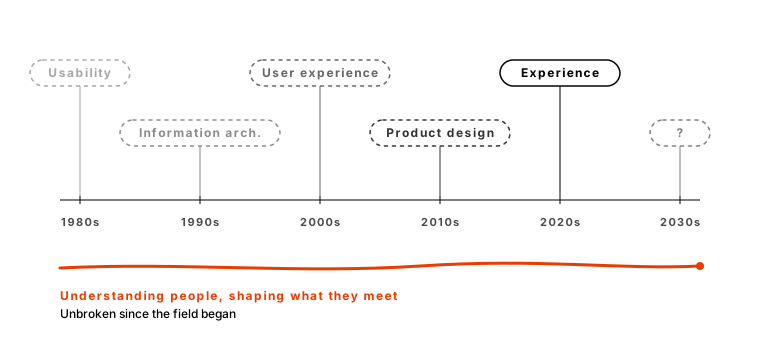
Underneath every one of those names, the job was the same: understand how people actually behave, then shape what they encounter so it works for them. That is the constant. Everything else, including the word “design,” is packaging that has been replaced before and will be replaced again.
The title has expired four times in forty years. The work has not expired once.
The work is growing and the entry rung is gone
Demand for people who understand how people meet systems is going up, not down. Every industry I work in is putting more of its relationship with people through software, and now through models, than it did five years ago: hospital networks, universities, insurers. Somebody has to decide what those systems should do to the people on the other end. That is not a shrinking job.
What is shrinking is the job of drawing the screens. A working prototype arrives on my team before lunch now, and the person who made it did not lay out a single frame by hand. Wireframes, first-pass layouts, the third revision of a flow: the tasks that filled a junior designer’s week are the tasks a model does adequately today and will do well by 2030. So the entry-level market is getting harder, not because there is less work, but because the rung most people climbed in on is gone. The industry has not yet built the replacement rung, and that is the real risk to the profession: not extinction, but a pipeline that stops producing seniors.
Bet on the accountabilities, not the titles
I would not bet on any single title. I would bet on the accountabilities, because titles follow those, and four are already forming.
Someone will own the strategy: which experiences the organization builds, why, and the number that proves it worked. Today that person is often called a design strategist or an experience strategist, and the title matters less than the fact that they sit in the roadmap conversation rather than downstream of it.
Someone will own the relationship between a person and an AI system: how much it does on its own, when it asks, where it stops. Call it AI experience design or agent design. It is the fastest-growing job I can see, and almost nobody doing it trained for it. When my team shipped one, we wrote the rules as we went.
Someone will own the moments that have no screen: voice in a car, gesture in a headset, a room that responds to who walked in. The old title, interaction designer, is probably coming back for this, with “multimodal” bolted on until that word stops being necessary.
And someone will own the people. As machines take the production, the scarce thing becomes judgment, and judgment is grown by leaders who assign practice on purpose and narrate their reasoning in front of the work. That job is called a design lead or a head of experience now, and it will matter more, not less.
Less drawing, more deciding
That is the short version. Here is the long one.
You will write the system more than the screens. Interfaces will be composed at the moment of use, for one person, by something reading rules a designer authored: what must be true of every rendering, what must never appear, which questions the first screen has to answer. Those rules are design. They are also where your judgment survives once you are not drawing the output yourself.
You will edit more than you make. Working with generative tools is closer to editing than drafting: reading fluent output for what it hides, cutting what is plausible but wrong, refusing to let polish stand in for thinking. Taste stops being the finishing pass and becomes the deliverable.
You will be the oversight. A system that composes an interface per person composes the dark pattern per person too, and nobody signed off on it. Privacy, honesty about what the system is doing, whether it works for someone on a screen reader, whether it leaves a person calmer or more anxious than it found them: those become the designer’s responsibilities, because the designer is the only person in the loop paid to care about the human on the other side.
You will work across touchpoints that do not belong to you. People already ask an assistant before they visit your site, and the assistant’s answer is the first impression. The journey runs through surfaces you did not design and cannot see in analytics, and designing for it means designing for machine readers as well as human ones.
And the thing you are designing for will not have changed at all. Working memory still holds a handful of items. People still trust what is easy to process and weigh losses about twice as heavily as gains. Miller published on the limits of short-term memory in 1956; Kahneman and Tversky described loss aversion in 1979. Both will hold in a headset exactly as they held on a web page. A designer whose value sits in the tool depreciates on the tool’s schedule. A designer whose value sits in understanding people appreciates.
Move before the title does
None of this rewards waiting for the title to settle. Here is what I am doing and what I tell my team.
- Work with the tools every day, as a collaborator. Let them take the layout pass and the first cut at synthesis, then put the hours into the problem. I build in code most days and keep a lab for this reason. You cannot direct a system you have never operated.
- Attach yourself to a business outcome. Learn which number your work moves and say so in the language the product manager and the CFO use. “This change raised completion by a fifth” is a sentence that has a job in any version of the future. “I made these screens” is not.
- Design one thing with no screen. A voice flow, a spatial prototype, an experience for a car. Not to specialize, but to separate what you know about people from what you know about rectangles. Most designers have never had to.
- Specialize in what automation cannot reach: research, behavioral science, or the architecture of the design system itself, which is about to become the thing the machine reads rather than a kit humans assemble by hand.
- Keep some work by hand. The apprenticeship that used to build judgment as a byproduct of production is gone. Assign yourself the reps, and if you lead people, assign them theirs.
I expect to be wrong about the names. Everyone who has predicted titles in this field has been. But the work has survived every rename so far by moving to wherever the decisions about people were being made, and that is where it is moving now. Go there before the title catches up.

Director of Experience at Primacy. I find the order complex systems are missing: experience strategy, information architecture, and design systems for hospital networks, universities, and insurers.
Keep reading
- Jul 20, 2026
I stopped renting my portfolio
Squarespace, Adobe Portfolio, Framer, Webflow, Nextra: five rented portfolios in, my site still didn't feel like mine. So I built the sixth by hand.
PracticeCraftAI6 min - Jun 10, 2026
The prototype is the spec
Forward-thinking teams are trading static, text-heavy PRDs for working, clickable prototypes built fast with AI. The spec is becoming something you use, not something you read.
PracticeAIPrototyping4 min